I remember sitting with a generic Arabic workbook, staring at the first page, and feeling a knot in my stomach. I looked at my toddler, then back at the page, and thought, “Am I actually qualified to do this? What if I confuse them? What if I teach it wrong?”
If you have ever felt or still feeling that way, I want you to take a deep breath.
Teaching Arabic letters at home doesn’t require a degree in education or perfect fluency. In fact, I’ve learned that children don’t need perfection from us. They just need consistency, a little bit of fun, and a routine that feels safe.
Over the years, I’ve ditched the strict "classroom" vibe for a method that actually works for my young beginners. Here is the exact, stress-free approach I use to teach Arabic letters at home and how you can do it too using things you already have.
1. The "No-Pencil" Rule: Recognition First
In the beginning, I made the mistake of handing my child a pencil right away. Tears ensued. Now? I have a strict rule: Put the pencil down.
Before we ever worry about handwriting, I focus entirely on recognition. Can they point to the letter? Can they say its name? Can they spot it in a lineup?
I keep this incredibly light. We spend about five minutes just looking at letters I’ve drawn on index cards or pointing at colorful letters in a book. No pressure, just exposure.
2. I Don't Teach in "Alphabetical Order"
Here is a little secret that changed everything for us: Teach in shape families.
Trying to memorize the whole alphabet in order can be confusing because the shapes change so much. Instead, I group them by their "lookalikes."
- The Boat Brothers: ب ت ث
- The Belly Sisters: ج ح خ
- The Teeth/Twin Family: س ش
When I teach these letters side-by-side, my kids grasp the patterns much faster. They start looking for the dots immediately!
Tip: You don’t have to come up with the names yourself! Kids have the best imaginations, so let them lead. Just ask: “What does this shape remind you of?” When they come up with the answer even if it’s silly, they remember it forever.
3. Get Messy: The Sensory Approach
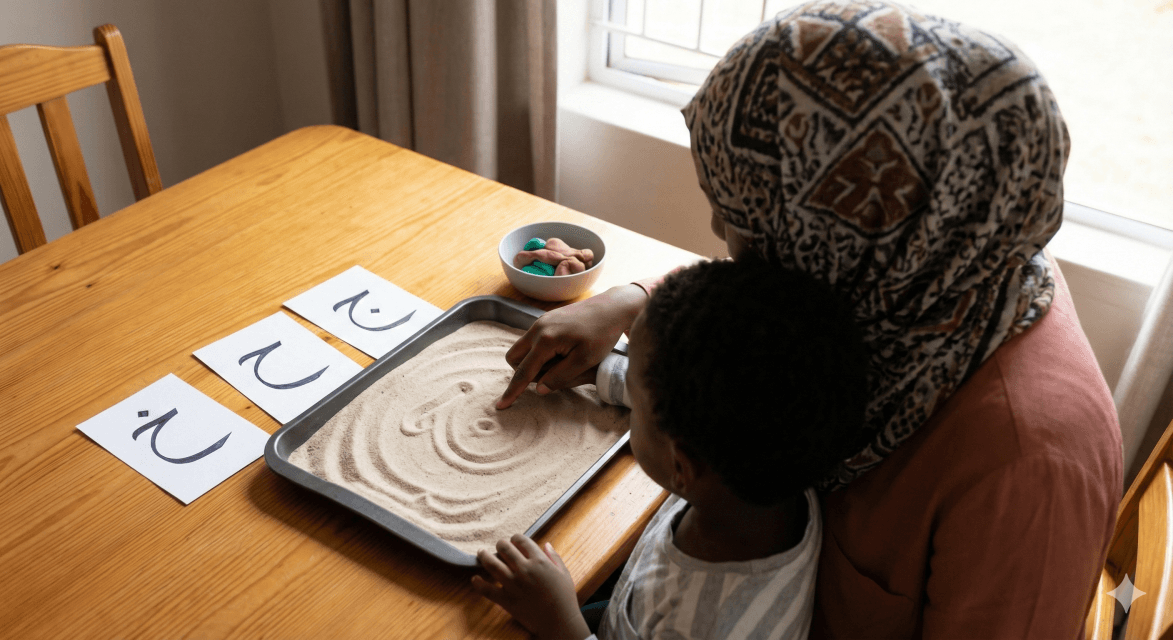
If you want a child to remember a letter, let them feel it. Kids are tactile learners; their fingers are their best tools.
We love getting a little messy using things from the kitchen or around the house:
- Rice/Sand Tracing: Pour some uncooked rice or salt into a baking tray and let them draw the letter Alif with a finger.
- Playdough: Roll out "snakes" to form the shape of Baa.
- Air Writing: Use your whole arm to "paint" the letter in the sky.
This creates "muscle memory" for the shapes before they ever hold a pen.
4. The 10-Minute Sweet Spot
I used to try and force 30-minute lessons. By minute 12, we were both frustrated.
Now, my golden rule is 10 minutes a day. That’s it.
- 5 minutes of recognition.
- 3 minutes of sound practice.
- 2 minutes of a quick game.
Consistency beats intensity every single time. A happy 10-minute session is worth far more than a stressful hour.
But here is the reality check: It doesn't even have to be 10 minutes in one sitting. You can do five minutes in the morning and five in the evening. And if your child has a shorter attention span? Stop at five minutes! A happy, short session is worth far more than a stressful long one.
5. Sounds Over Names (The Phonics Trick)
While knowing the name "Jeem" is important, knowing the sound "Ja" is what will eventually help them read the Quran.
I introduce the sounds immediately. Instead of just saying, "This is Baa," I’ll add, "This is Baa, and it makes the 'b' sound, like Bab (door)." This small shift makes the transition to reading words so much smoother later on.
6. The "Mushaf Hunt"
This is my absolute favorite way to bring Arabic into our everyday life. We don't just keep Arabic for "lesson time."
We turn it into a detective game. I’ll open the Mushaf, or point to a poster on the wall, and ask:
- "I spy with my little eye... the letter Seen! Can you find it?"
- "Which letter is hiding in this word?"
It connects their learning to their Deen in a natural, loving way.
7. Gamify the Learning
If I say "Time for class," they run away. If I say "Time to play a game," they come running.
I rotate between a few zero-prep games to keep the energy high:
- Flashcard Treasure Hunt: I hide simple handwritten cards around the living room and they have to find them and shout out the letter name.
- Memory Match: A classic flip-over game with two sets of cards.
- The "Missing" Letter: I put three cards down, tell them to close their eyes, take one away, and ask, "Who went missing?"
8. Writing Comes Last
Remember the "No-Pencil" rule? Eventually, we do break it. But only when they are ready.
Once they can confidently recognize the letters, I gently introduce fine motor skills. We start with finger tracing, move to dry-erase markers on a whiteboard (which is easier to slide than a pencil on paper), and eventually, pencil practice.
Slow and steady wins this race.
9. My Simple Weekly Routine
If you are wondering how to fit this into a chaotic week, here is the exact schedule I follow. It keeps us structured without the burnout:
- Monday: Introduce the new letter (or group).
- Tuesday: Focus on the sounds/phonics.
- Wednesday: Sensory activity (Playdough or Rice).
- Thursday: Games & Matching.
- Friday: Tracing practice.
- Weekend: Light review (or just spotting letters in real life).
10. You Don’t Have To Reinvent the Wheel (Or Spend a Fortune)
When I started, I thought I needed fancy materials. I didn't.
Some paper, markers, and things from your home are enough to start. The most valuable resource you can give your child isn't an expensive curriculum - it's your patience and your presence.
Final Thoughts
Teaching Arabic at home is a marathon, not a sprint. Whether you are just starting with Alif or you are restarting after a long break, remember that your effort is Sadaqah Jariyah.
Keep it simple, keep it fun, and trust the process. You are doing a wonderful job, Mama❤️.
How about you? Do you have a favorite activity for teaching letters? Let me know in the comments below and don't forget to subscribe to our newsletter!
Barakallahu Feekum.
✍️OmmSulaim